Christmas in Italy: 30 Holiday Words and Phrases to Know
Christmas in Italy is less a single day than a season with its own vocabulary. It begins around 8 December, when the tree and the presepe go up, runs through the fish dinner of the Vigilia, the long lunch on the 25th and Santo Stefano the day after, and ends with La Befana on 6 January. Along the way you will be offered panettone, asked about your plans, and wished auguri by complete strangers in the street. The words are practical as well as festive: they tell you when shops close, what to bring to a dinner, and how to answer an invitation without sounding rude. Here are thirty words and phrases that cover the whole stretch: what they mean, and how people actually use them.
Greetings and dates you will hear first
Start here, because these six come up daily from early December onward. They are also the ones you are most likely to need in shops, offices and stairwells, where a quick greeting does a lot of social work.
- Buon Natale — Merry Christmas, literally "good Christmas". It works with anyone: your landlord, a barista, your mother-in-law. Say it up to the 25th; after midnight on Christmas Day, many people start switching to Buon anno, though you will still hear Buon Natale over lunch.
- Buone Feste — "happy holidays", plural, covering Christmas through Epiphany. It is the safe choice in a shop or office when you are not sure what the other person celebrates, or when you will not see them again until January. It is also the standard sign-off in work emails sent on 23 December.
- Auguri — best wishes. Italians use it for birthdays, exams, new flats and job interviews, so in December you will hear it constantly. Tanti auguri is the warmer version, and auguroni is the enthusiastic one people use with friends. The natural reply is Grazie, altrettanto — thanks, same to you.
- L'Immacolata — 8 December, a public holiday. Traditionally the day the decorations come out, though plenty of families start earlier. In many towns it is also the day of the first Christmas market and the first round of vin brulè.
- La Vigilia — Christmas Eve. The evening meal is the cenone della Vigilia, and in many coastal and southern regions it is fish-based and meat-free. It is usually a late meal, and in some families it is almost as important as Christmas lunch itself.
- Santo Stefano — 26 December, also a national holiday. The day of leftovers, long walks and visits to relatives you did not manage to see on the 25th. Shops may be closed, and the streets fill up in the afternoon with families trying to walk off the panettone.
Two small grammar points save a lot of awkwardness. Italians say a Natale for "at Christmas" (A Natale vado dai miei — I'm going to my parents' for Christmas) and per Natale for "for Christmas" when talking about gifts or plans. Never in Natale. And the pronunciation is gentler than it looks: Buon Natale runs together as boo-OHN nah-TAH-leh, with a clean double t.
A Natale vado dai miei, ma per Natale quest'anno resto qui. — I'm going to my parents' for Christmas, but this year I'm staying here for Christmas.
At the table: seven words that earn their place
December in Italy is a month of boxes. Colleagues arrive at the office carrying panettone, neighbours drop one off, and the kitchen counter slowly fills with them. Knowing the names makes you a participant rather than a spectator, and it also helps you choose the right host gift when you are invited to lunch.
- Panettone — the tall, domed Milanese cake with raisins and candied peel, cut into tall wedges rather than horizontal slices. It is often served with a spoonful of mascarpone on the side, or with a small glass of spumante.
- Pandoro — the star-shaped Veronese cake, plainer and buttery, sold with a sachet of icing sugar to shake over the top. It is lighter than panettone and often served with cream or a warm drink.
- Torrone — nougat with almonds or hazelnuts and honey. Cremona is the classic source, but nearly every region has its own version, from soft and chewy to hard and brittle, sometimes dipped in chocolate.
- Struffoli — tiny fried dough balls bound with honey and sprinkles, a Neapolitan fixture that disappears fast. They are sticky, small and dangerous to leave near a group of children.
- Baccalà — salt cod, the backbone of many Christmas Eve tables, often cooked with tomatoes, olives or chickpeas. It also appears fried, stewed or baked, depending on the region and the family recipe.
- Cotechino e lenticchie — pork sausage and lentils on New Year's Eve. The lentils are said to look like small coins, and everyone eats them "for luck" without much conviction. The cotechino is usually sliced thick and served with purée or lentils.
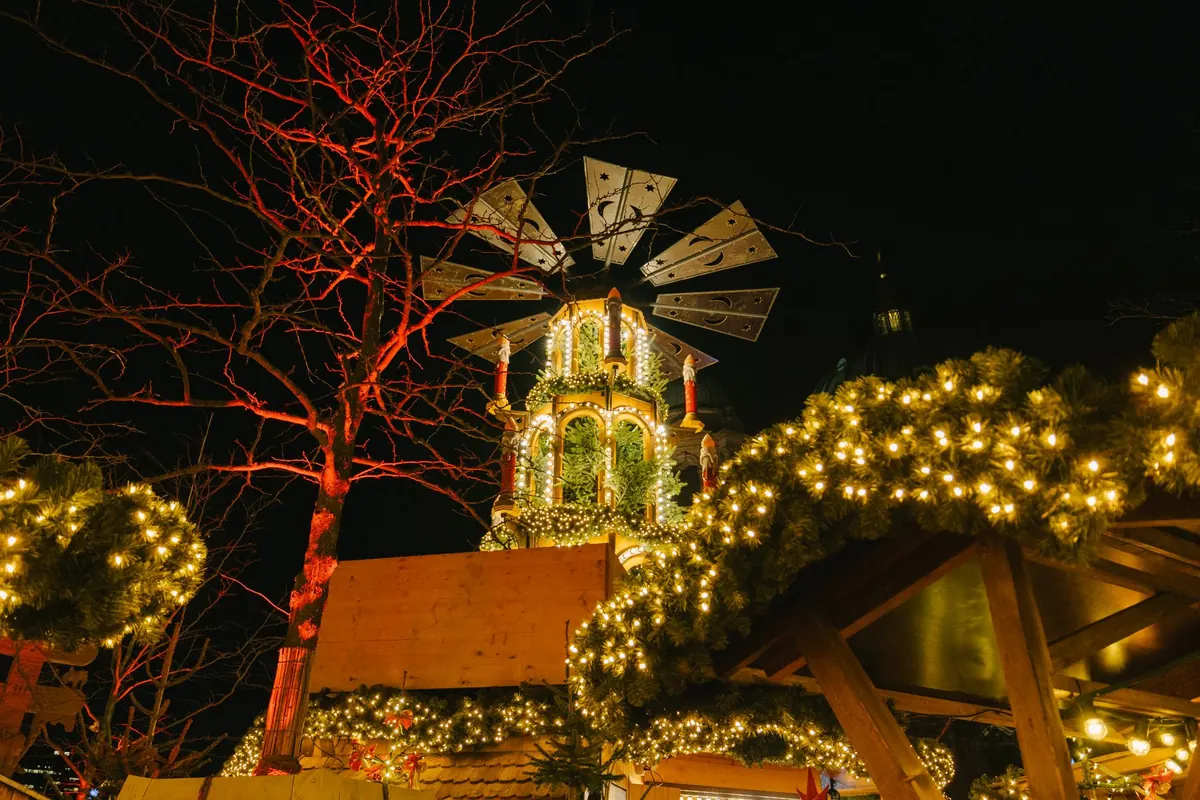
- Vin brulè — mulled wine, sold at Christmas markets and worth ordering on a cold evening in the north. It is warm, spicy and sweet, and it is one of the few things that makes standing in a crowded market square pleasant in December.
The panettone-versus-pandoro debate splits households the way football loyalties do, so it is best to praise both. If someone offers you a slice, un trancio, grazie is the right phrase for panettone; for pandoro, una fetta. At a pasticceria, ask for un panettone artigianale and specify how many people it is for — the assistant will size it for you. If you are the guest, a panettone or pandoro is a reliable host gift; if the host already has three, a bottle of spumante or a box of torrone is a safe alternative.
How to accept a second slice without starting a war
Italian hosts are persistent, and refusing food can take more vocabulary than accepting it. È buonissimo, ma davvero non ce la faccio — it's delicious, but I really can't manage any more — is polite and clear. Prendo solo un assaggio — I'll just have a taste — is useful when you want to be sociable without committing to a full slice. And if you do want more, un trancio piccolo, per favore — a small slice, please — keeps things manageable.
Decorating: the presepe, the tree and what hangs on it
The vocabulary of an Italian living room in December is unusually specific, and children learn it early. Many families have both a tree and a presepe, and the two are not in competition: the tree is decorative, while the presepe is often the emotional centre of the room.
- Il presepe — the nativity scene, complete with statuettes, the manger, the star and often a whole miniature village of bakers, shepherds and running water. Many families set it up on 8 December and add the baby Jesus on Christmas Eve; some towns stage a presepe vivente, a living nativity with real people and animals.
- L'albero di Natale — the Christmas tree. Fare l'albero means to put it up and decorate it, and it is often a family operation involving tangled lights and at least one broken bauble.
- Le palline — baubles and tree ornaments. The word literally means "little balls", so it covers everything from cheap coloured spheres to inherited glass decorations.
- La stella — the star on top of the tree, and also the star of Bethlehem in the presepe. In some families the person who places the star gets to declare the decorating officially finished.
- Il bambinello — the baby Jesus figurine, added last to the manger. Children often take turns placing it, and in some households it stays out of the scene until Christmas Eve.
- La calza — the stocking. In Italy it is associated less with Santa and more with La Befana, who fills it with sweets or coal on the night before Epiphany.
- Babbo Natale — Father Christmas, or Santa Claus. He appears in shops, advertisements and school plays, but in many traditional Italian families the presepe and La Befana still matter more than a chimney visit.
If you are invited into an Italian home in December, a small compliment about the presepe is always welcome, especially if you notice a detail such as the baker or the running water. Che bel presepe — what a lovely nativity scene — is enough.
Traditions, games and the language of the table
The Christmas season is also a schedule of meals and games, and the words below are the ones that tell you what is about to happen next.
- La tombola — a bingo-like game played at Christmas lunch or after dinner. Each player has a cartella, a card with numbers, and the caller draws from a bag. Small prizes are normal, and the game can last longer than anyone planned.
- Il cenone — the big evening meal, especially on Christmas Eve or New Year's Eve. Il cenone della Vigilia is the Christmas Eve dinner, while il cenone di San Silvestro is the New Year's Eve one.
- Il pranzo di Natale — Christmas lunch. It is usually long, multi-course and starts early in the afternoon, then runs on until it is almost dark. Do not make other plans for the evening.
- Il brindisi — a toast, made with a glass in hand before dessert or at midnight. The usual words are Cin cin or Salute, and everyone is expected to raise a glass.
- Lo spumante — sparkling wine, whether prosecco, Franciacorta or another label. It is the default drink for a toast, and a bottle often appears at the end of the Christmas lunch.
At a Christmas lunch, the safest strategy is to arrive hungry but not too early, accept a small portion of everything, and save room for the panettone. The table is not a race, but it is a marathon with several dessert courses.
New Year and Epiphany: the last stretch
Christmas in Italy does not stop on 26 December. The season rolls on through New Year's Eve and Epiphany, and the vocabulary changes with it.
- La Befana — the old woman on a broomstick who brings sweets to good children and coal to naughty ones on the night before Epiphany. She is one of the most beloved figures of the Italian winter, and the rhyme La Befana vien di notte is learned by every child.
- Buon anno — Happy New Year. You will hear it from late December onward, often alongside Felice anno nuovo. After Epiphany, people finally stop wishing it and settle into January.
New Year's Eve is San Silvestro, and the table usually includes cotechino e lenticchie, followed by fireworks in the piazza. Then comes Epiphany, with a final public holiday and the saying L'Epifania tutte le feste porta via — Epiphany takes all the holidays away. The tree may stay up a little longer, but the season is officially over.
Useful phrases for plans and goodbyes
Finally, three phrases that turn vocabulary into conversation. They are useful at work, with neighbours and at the end of a long lunch.
- Dove passi il Natale? — Where are you spending Christmas? Literally "where do you pass Christmas", and a very common question in December.
- A casa dei miei — at my parents' place. It is the standard answer for many Italians, and it can be followed by the region or town: A casa dei miei, in Puglia.
- Ci vediamo dopo le feste — see you after the holidays. It is the perfect goodbye on the last working day before Christmas, and it avoids the awkward question of exactly when everyone is back.
Thirty words will not make you fluent, but they will get you through the season: the greetings, the boxes of panettone, the presepe compliments and the final auguri in the street. Use them early, use them often, and remember that in Italy a good wish is rarely refused.
Photo: Sebastian Luna / Pexels