Italian Food Shopping Checklist: 40 Words for Markets and Delis
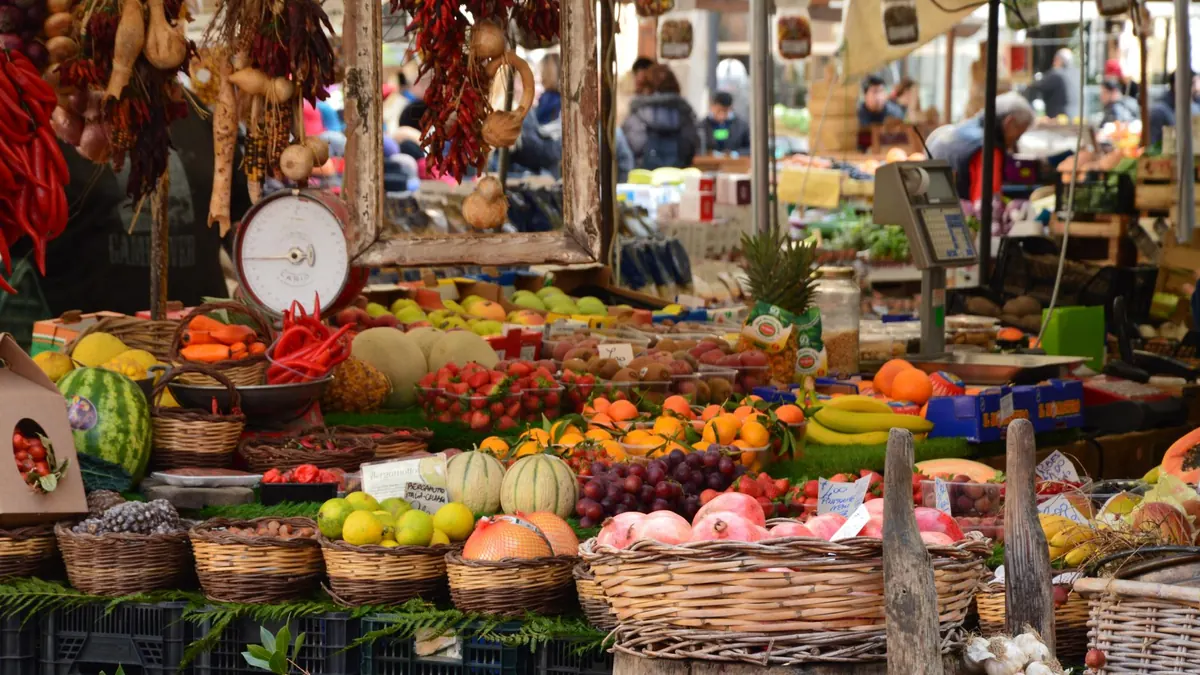
Saturday morning at a neighborhood market is not a language exam, but it can feel like one. The cheese counter is busy, the baker is already reaching for the next loaf, and the person behind you knows exactly what they want. A short, reliable vocabulary makes the difference between pointing at something and getting the piece you actually meant to buy. Use this checklist as a route through the shop: places first, then quantities, then the words for cheese, bread, produce, and cold cuts. Read it once before you go; keep it open while you wait.
First, the Places and the Quantities
Italian food shopping starts with knowing where you are. A mercato is a market, often with several stalls; a bancarella is one stall. A salumeria sells cold cuts, cheese, and prepared foods; a panetteria sells bread; a fruttivendolo is the greengrocer; a macelleria is the butcher’s shop. These are useful on signs, but also in speech: “C’è un fruttivendolo qui vicino?” is a normal way to ask for the nearest produce shop.
- Mercato — market
- Bancarella — stall
- Salumeria — deli
- Panetteria — bakery
- Fruttivendolo — greengrocer
- Macelleria — butcher’s shop
- Etto — 100 grams
- Chilo — kilogram
Quantities without a calculator
In most delis and cheese counters, you order by etto (100 grams) or chilo (kilogram). “Un etto” is a small taste; “mezzo chilo” is a generous family portion; “due etti” is 200 grams. At a market stall, ask “Quanto costa?” before you commit, especially for produce sold by weight. If you want a whole piece rather than a slice, say so early: “Vorrei un pezzo intero.”
At the Cheese Counter
Cheese is where a little precision pays. Formaggio is the general word; after that, names matter. Pecorino is made with sheep’s milk, parmigiano is the familiar aged cow’s-milk cheese, mozzarella is soft and usually eaten fresh, and gorgonzola is blue and creamy. Stagionato means aged; fresco means fresh. Ask for grattugiato if you want it grated for pasta or soup.
- Formaggio — cheese
- Pecorino — sheep’s-milk cheese
- Parmigiano — Parmesan
- Mozzarella — mozzarella
- Gorgonzola — blue cheese
- Stagionato — aged
- Fresco — fresh
- Grattugiato — grated
Vorrei un etto di pecorino stagionato e una fetta di parmigiano, per favore.
Use fetta for a slice and pezzo for a piece or wedge. If you are unsure, ask “Posso assaggiare?” — may I taste? At a market, tasting is often part of the transaction. At a small shop, it is still a polite request, not a demand.
Bread: Shape, Crust, and Crumb
Bread names change from region to region, so learn the shapes you see most often. Pane is bread in general. A pagnotta is a round loaf; a filone is a long loaf; a rosetta is a small roll with a crisp crust; focaccia is a flatbread, often sold by weight. Integrale means wholemeal.
- Pane — bread
- Pagnotta — round loaf
- Filone — long loaf
- Rosetta — small roll
- Focaccia — flatbread
- Integrale — wholemeal
Ask for “un filone, non troppo cotto” if you want a lighter bake. If you need it sliced, say “Lo può affettare?” The crosta is the crust; if you plan to eat the bread tomorrow, a thicker crust often keeps better. For a quick lunch, a rosetta is easier than a whole pagnotta. If you have an allergy or need detailed flour information, ask the baker directly and check any packaging; small bakeries may not have full labels.
Produce: Ripe, in Season, and Enough
At the fruttivendolo, you will hear frutta (fruit) and verdura (vegetables). Maturo means ripe; acerbo means unripe. If you are buying for the week, ask for a mix: “Uno maturo e uno meno maturo.” Di stagione means in season, a useful phrase when you want what is currently good rather than imported. Biologico means organic; ask “È biologico?” if the sign is not clear.
- Frutta — fruit
- Verdura — vegetables
- Maturo — ripe
- Acerbo — unripe
- Di stagione — in season
- Biologico — organic
A mazzo is a bunch, handy for herbs such as parsley or basil. For tomatoes, the seller may ask “Quanti ne vuole?” — how many do you want? Answer with a number or “un chilo.” If you are choosing for a specific dish, say what you need: “Vorrei delle verdure per una insalata.” The seller can then point you to the right basket.
Cold Cuts: Sliced to Order
At a salumeria, the assistant will often ask “Come lo vuole?” — how would you like it sliced? Prosciutto can be crudo (cured) or cotto (cooked); salame is salami; mortadella is the pale pink sausage from Bologna; bresaola is air-dried beef; coppa is cured pork shoulder. Affettato is the general word for sliced cold cuts.
- Prosciutto — cured ham
- Salame — salami
- Mortadella — mortadella
- Bresaola — air-dried beef
- Coppa — cured pork shoulder
- Affettato — sliced cold cuts
- Sottile — thin
- Spesso — thick
For texture, use sottile (thin) and spesso (thick). A common order is “un etto di prosciutto crudo, affettato sottile.” If you want a little of several things, ask for “un etto di questo e un etto di quello.” For a picnic, thicker slices travel better; for a sandwich, thin slices fold more easily. If you have allergies or avoid certain ingredients, ask directly and read labels when they are available, because recipes vary by producer.
A Practical Closing Checklist
Before you join the queue, decide what you need and how you will ask for it. This short sequence keeps the visit smooth:
- Choose the place: mercato, bancarella, salumeria, panetteria, fruttivendolo, or macelleria.
- Set the quantity: etto for a taste, chilo for a family, or a specific number of pieces.
- Name the texture or age: sottile or spesso for cold cuts; stagionato or fresco for cheese.
- Ask for a fetta, a pezzo, or a mazzo when you do not need a whole piece.
- Check the crosta on bread and ask for slicing if you need it that day.
- Finish with “Grazie” and, if you plan to return, “A domani” or “Arrivederci.”
Keep this list on your phone or write the key words on a shopping note. The goal is not to sound like a textbook; it is to leave the shop with the cheese you meant, the bread you like, and enough prosciutto for lunch.
Photo: SlimMars 13 / Pexels